Stop guessing why the WiFi is bad. A measured site survey walks your building with professional tools and turns the complaints into a heat map — exactly where coverage collapses, what's interfering, and the costed fix. It's the engineering step that makes everything after it cheaper.
Prefer to talk? Call Chris — 0412 853 618
One floor or a whole campus — send through your details and Chris will get back to you with straight advice and a fixed price for the survey. Prefer to talk? Call 0412 853 618. No pushy sales, just solid measurement.
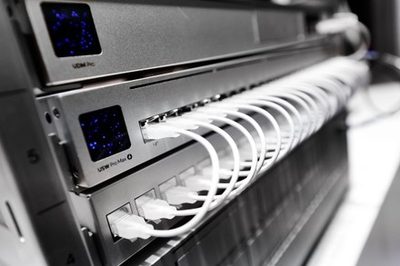
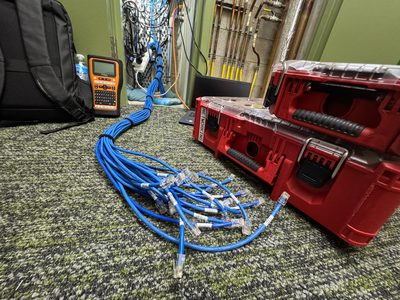
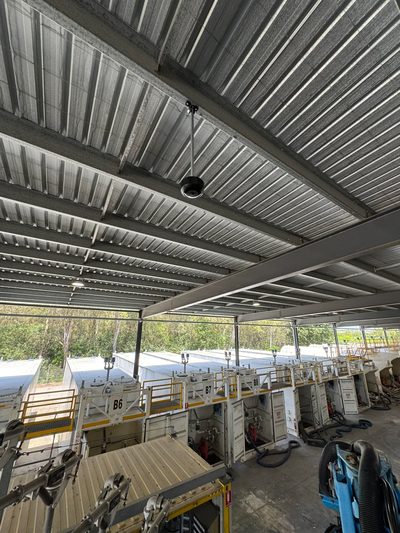
Every dollar spent on wireless hardware without a survey is a guess. A WiFi site survey replaces the guessing: professional tools measure signal strength, noise, channel congestion, and interference across your actual building, and the results become a design — how many access points, which models, exactly where, and what cabling feeds them.
Unified Network Solutions runs wireless site surveys across Brisbane and South East Queensland for offices, warehouses, schools, clinics, and venues — before fitouts, before upgrades, and especially before anyone buys hardware to fix a problem nobody has measured. The survey output is a plain-English report with heat maps and a fixed-price recommendation, and if we implement the design, the survey cost is typically credited into the project.
The phrase gets used loosely in the industry, so here's what we mean by it. A heat map is your floor plan coloured by measured reality: green where signal is strong, amber where it's marginal, red where the complaints come from. We walk the site with survey tools recording hundreds of measurement points per floor, on every band your devices use.
Heat mapping during the survey also captures the time dimension where it matters — a venue measured mid-service and a warehouse measured mid-shift look nothing like their quiet-hour selves, and the design has to serve the loud hour. The map itself does two jobs. It ends the debate — "the WiFi is fine" and "the WiFi is unusable" stop being opinions when the corridor is green and the finance pod is red. And it localises the cause: a hard coverage boundary at a wall says masonry; a noisy mess across one zone says interference; strong signal with terrible performance says congestion or cabling, not radio.
You receive the heat maps in the report alongside the channel and interference analysis, annotated so a non-technical owner can follow the story they tell — evidence you can act on, whoever ends up doing the work.
Both are real survey types with different jobs. Quoting one when the situation needs the other is how WiFi projects go sideways.
Predictive (desktop) survey. Coverage modelled from floor plans, materials, and device budgets — the right tool before walls exist: new fitouts, new builds, tender responses. Fast and remarkably accurate when the construction inputs are honest.
On-site (measured) survey. The real building, walked and measured — capturing what no model knows: as-built materials, the neighbour's twelve networks, the fridge motor stomping on 2.4GHz. The gold standard for existing buildings with problems.
Validation survey. The third kind nobody mentions: after an installation, the site is re-walked to prove the design delivered. We include it on every install we do — coverage verified, not assumed.
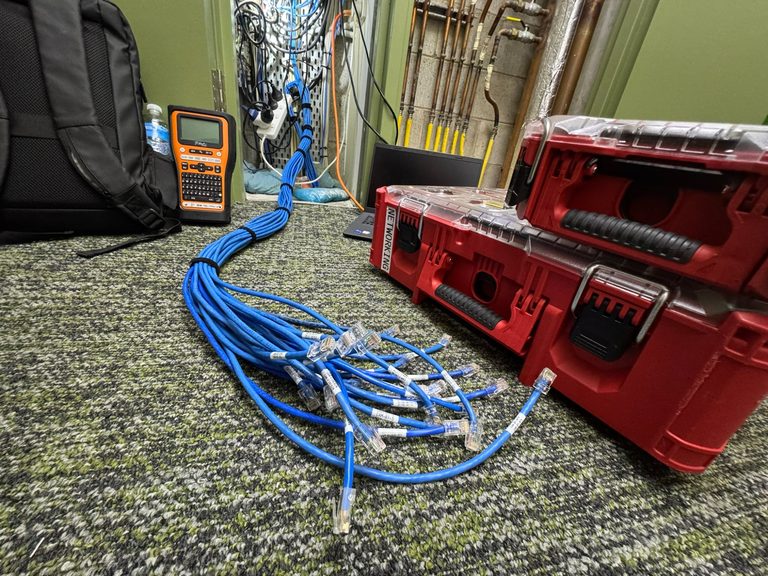
During an office fitout, a predictive wifi site survey turns wireless from an afterthought into a construction line item: access point positions designed from the floor plan, their cable runs priced into the rough-in, mounting coordinated with the ceiling grid. The WiFi is live before the furniture arrives.
Skip it, and the sequence runs the expensive way — move in, discover the boardroom and the back pod are dead zones, then pay retrofit rates to open finished ceilings while your team hotspots their way through week one in the new office. The survey usually costs less than relocating one access point after handover.
For bigger deployments — multi-floor offices, warehouses and campuses — the predictive design gets validated on-site as construction closes in, so the final AP plan reflects the building as built, not as drawn.
The buildings where surveys matter most are the ones where guessing is most expensive — and warehouses are the textbook case.
A warehouse's radio environment isn't static: stock levels change the signal paths daily, racking creates canyons a floor plan never shows, and the devices that matter — RF scanners, voice pickers, tablets — roam at floor level all shift. A wireless site survey for a warehouse measures with the racks loaded and the operation running, because an empty-shed survey describes a building that doesn't exist on a working day.
The survey output drives real money decisions: AP mounting heights that serve aisles rather than the ceiling void, antenna choices for canyon coverage, and roaming thresholds tuned for devices that cross the site fifty times a shift. Getting that design right from measurement costs a fraction of discovering it wrong from mis-picks.
High-stakes environments get the same treatment for different reasons. School surveys model class-change surges — a corridor of students is a moving load spike. Medical sites need every room covered with zero dead zones, because nurse-call tablets don't get to "mostly work." Venues are capacity puzzles: the survey measures the room at its busiest, not its emptiest.
In each case the wifi site survey is the difference between a network specified for the brochure version of the building and one specified for the building on its worst hour — which is the only hour anyone remembers.
"The WiFi is slow" has at least five different causes with five different price tags — and hardware vendors will happily sell you a fix for the wrong one. The survey's job is telling you which one you actually have before any money moves.
Signal physically not reaching — visible instantly on the heat map as red zones. Fix: an access point where the people are. Usually the cheapest outcome.
Your own access points fighting on overlapping channels — strong signal everywhere, performance nowhere. Fix: channel planning and power tuning. Often free.
Twelve other tenancies' networks sharing your airspace, worst in CBD towers. Fix: band strategy and channel discipline the neighbours haven't thought of.
Microwaves, motors, wireless cameras, old cordless gear — invisible to WiFi scanners, found by spectrum analysis. Fix: remove, shield, or design around the source.
A marginal cable run, a failing switch port, an overloaded uplink — wireless symptoms with wired causes. As registered cablers, we test the wire too — see WiFi diagnostics.
Sometimes the survey says your hardware is fine and one setting is wrong. We tell you that and charge for the survey — not for the rebuild you didn't need.
Floor plans, problem history, and what the wireless needs to do — surveys are scoped to the questions you need answered, not a one-size template.
We walk the building with survey tools during working hours — capturing signal, noise, channels, and interference in the radio environment your team actually lives in.
Heat maps, analysis, causes, and a specific recommendation with a fixed implementation price — delivered within two business days.
Implement with us and the survey cost typically credits into the project — the survey becomes the design, and the design gets validated after install.
A survey is only as good as what its author can see — and most WiFi surveyors can't see the cabling.
ACMA Open Cabler #42489 with an IT background — when the cause is a cable and not the radio, we catch it in the same visit instead of selling you access points.
The report comes with a fixed implementation price, and the survey credits into the job — measurement, design, install, and validation from one accountable team.
White-label surveys for IT companies and MSPs — professional heat maps and designs under your brand, field work you don't have to staff.
A measured on-site survey with heat mapping for a typical single-floor Brisbane office starts around $500–$900, with larger or multi-floor sites quoted to scope. If you proceed to a WiFi installation with us, the survey cost is typically credited into the project — the survey becomes the design. Call Chris on 0412 853 618 for a fixed quote.
A heat map is your floor plan coloured by measured signal — strong zones, marginal zones, and dead zones, per band. We capture it by walking the site with survey tools while the system records signal strength, noise, and interference at hundreds of points. The result shows precisely where coverage collapses and why, turning "the WiFi is bad in the back" into an engineering diagram with a fix.
A predictive survey models coverage from your floor plan and construction details — fast and useful for new fitouts where the walls don't exist yet. An on-site survey measures the real building, capturing everything the model can't know: actual materials, neighbouring networks, interference sources. We use predictive design for pre-construction planning and validate on-site once the space exists; for existing buildings with problems, on-site measurement is the gold standard.
It's the cheapest WiFi insurance you can buy. A predictive survey during fitout planning puts access point locations and their cabling into the construction program — cabled at rough-in prices instead of retrofit prices, with no visible cabling and no dead zones discovered after move-in. The survey typically costs less than relocating a single access point after the ceiling is closed.
Yes — that's one of its main jobs. The survey separates the possible causes: coverage gaps, co-channel interference from your own access points, congestion from neighbouring networks, overloaded APs, or problems that aren't wireless at all (a failing cable or switch port). You get the actual cause documented, and a costed recommendation to fix exactly that.
A plain-English report: heat maps per band over your floor plan, an interference and channel analysis, identified problem areas with their causes, and a specific recommendation — AP counts, models, locations, and cabling — with a fixed price to implement it. The report stands alone: you can hand it to any installer, though most clients have us do the work the survey designed.
A single-floor office is typically surveyed in two to four hours on site, with the report delivered within two business days. Larger sites — warehouses, campuses, multi-floor buildings — scale with area. Surveys run during business hours work best, because the radio environment we measure is the one your team actually works in — neighbouring networks, machinery, and all.
We service Brisbane CBD, North Brisbane, South Brisbane, Gold Coast, Sunshine Coast, Ipswich, Logan, Moreton Bay, Redlands, and the wider South East Queensland region. For larger projects, we can service regional Queensland by arrangement.
We run wifi site surveys and heat mapping across Brisbane CBD and metro, Logan, Ipswich, Redlands, Moreton Bay, the Gold Coast, and the Sunshine Coast — offices before fitout, warehouses before automation projects, schools before device rollouts, and any building where the wireless is guilty until measured. The wireless site survey comes first because it makes every dollar after it accountable to data. Reports in two business days, fixed prices throughout, and the survey credits into the install if we do the work. A wireless site survey answers the coverage question before hardware spends a dollar — the wireless site survey is the cheap part of every great network.
Book a wifi site survey — we'll walk the building, map the truth, and hand you the fix with a fixed price attached. The arguments about the WiFi end the day the heat map arrives.
Call 0412 853 618 Book a Survey Online Unified Network Solutions